By Jamie A. Thomas, PhD
…one must ‘name the problem’ in terms of systemic assumptions, structures, rules, or roles that are flawed. Significant social change cannot happen until we are thinking on a systemic level.
– Dr. Bobbie Harro
Showcasing Our Creativity
What brings together 4-6 educators across disciplines, with the persistence of a sports team, and a passion for innovation?
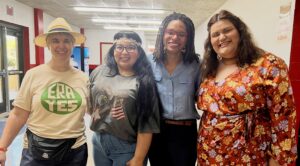
In this blog post, I describe my experience as an Open for AntiRacism (OFAR) advisory coach, and how key program events have supercharged my learning about Open and antiracist education and energized my ongoing contributions to the program. Across my multiple years as an OFAR coach and community college professor and administrator, I have seen cosmetologists and kinesiologists come together in conversation with biologists, psychologists, and librarians, all with the expressed goal of making college a more accessible and meaningful experience.
The sixth program year of OFAR saw a talented group of applicants rise to the occasion with projects that brought renewed creativity to a range of subjects, including art history, English composition, communication studies, computer science, earth and planetary sciences, and history.
So, upon the conclusion of another successful program year, on June 12, 2026, I cheered on as the group of faculty I had collaborated with for the past year described the lively discussions and increased student engagement that resulted from their scholastic experimentations. With textbook costs eliminated through incorporation of Open Educational Resources (OER) (for more about OER, see Lee, 2025), and an enhanced focus on cultivating learning experiences that extended beyond the classroom, these faculty’s students had expanded their learning in meaningful ways by, for example:
- Disseminating knowledge of local Latina activists through original speeches performed for family and friends and posted to social media,
- Collaborating with peers to craft a revisable writing rubric that rewards linguistic creativity and diversity,
- Going beyond their textbook to connect with local Tribal nations and explore Indigenous responses to climate change
In my role as an advisory coach for this group of faculty, I had worked to regularly meet with their collective over the course of the Fall and Spring semesters of the program. Our monthly Zoom meetings had, in fact, inspired me with discussions that circulated fresh suggestions of alternative textbooks on writing and composition, responsive AI policies, and online teaching strategies. In turn, I supported the team by sharing further resources, facilitating discussion, and encouraging everyone toward the program’s Action Plan timeline for drafting and implementation.
OFAR’s annual culminating event, the Team Showcase, provides space for celebration as well as reflection. Each team delivers a timed presentation that highlights their pedagogical innovations, challenges, and institutional impact. By the conclusion of the two-semester program, each member of a 4–6-person (multidisciplinary) faculty team—as facilitated by the team’s advisory coach—has developed and implemented an antiracist Action Plan for their teaching. The goal of the Action Plan is to put into practice and localize concepts of equity, opportunity, and access for community college students throughout California (For more about Action Plans, see the OEGlobal Voices Podcast, Episode 094).
Here is a view of a Showcase presentation from a recent OFAR Cohort:
Program Webinar in Review: Making Education More Open
As my team concluded their presentations during the Team Showcase, and yet another team took the stage, I took a moment to reflect on the year-to-date. Throughout my coaching experience, what I had leaned on was a sense of purpose developed from my expertise as a linguist, recent webinars hosted by the OFAR program, and readings I had personally absorbed on social justice and higher education.
One such webinar that has stayed with me, is the discussion presented by communication studies professor and OER advocate Dr. Jasmine Roberts-Crews in March 2026 via Zoom. During her presentation, she encouraged OFAR participants to reflect on what actions can make education truly more Open (see, for example, Roberts-Crews, 2023). Already, as part of the OFAR program, we had learned about open pedagogy as a move toward non-disposable assignments that guide students in amplifying their voices and connecting their classroom learning to the real world. Now, Dr. Roberts-Crews was reminding us of the range of Open values that OER and open pedagogy hold the potential to fulfill:
- Make education more accessible
- Make academic scholarship more accessible/free exchange of information
- Educational critiques of whose knowledge is valued and deemed as reliable (epistemic justice).
- Educational equity and justice
Dr. Roberts-Crews also described a cycle of contemplative pedagogy that she tentatively termed the “4Rs of Open Education”:
- Recognize
- Reflect
- Repair
- Revolutionize
When her webinar concluded on that day in March, I found myself thinking further about what it means to consider our roles as educators as part of a larger project in recognizing harms and gaps in curricula and initiating repair through our contributions in and beyond the classroom. The creativity, experimentation, growth, and perseverance that many OFAR participants discuss in their program reflection assignments and action plan updates demonstrate the value of intentionally examining our own beliefs, assumptions, and teaching practices.
Coaching Toward Liberation
Social justice scholar and educator Dr. Bobbie Harro (2010, 619) has described the personal process of unlearning and relearning as a Cycle of Liberation, with liberation defined as “critical transformation” that involves identifying the beliefs and social structures that enable and sustain thinking that is self-limiting and exclusionary to others. On the process of freeing ourselves from this kind of thinking, Dr. Harro, drawing inspiration from celebrated educator Paulo Freire (1921-1997), writes:
“By this I mean that one must ‘name the problem’ in terms of systemic assumptions, structures, rules, or roles that are flawed. Significant social change cannot happen until we are thinking on a systemic level.”
The work of identifying or recognizing, as Dr. Roberts-Crews has put it, the problems we see and the systemic challenges that we face, is an important step toward envisioning a more equitable future.
In my work with the OFAR program, I have come to understand the role of the coach as related to assisting our colleagues in moving toward liberation in their acts of teaching. Coaches provide resources and assist team leaders in rallying their crew around common purpose, with a view toward collective impact.
Coaches also listen and take notice of a participant’s goals, and they ask adaptive questions designed to help orient thinking toward those goals. We ask, “What’s your student story?” and embolden participants to consider the help they did or didn’t receive throughout their own previous experience as college students (see, for example, Thomas 2025). We ask what-ifs that encourage participants to imagine a path to actualizing changes that are within their reach: “How might flexible course policies have helped you along in your journey? What can a more welcoming syllabus do for you and your current students?”
Conclusion:
With the mid-June event day edging toward its conclusion, affirmations chorused around the Zoom room of attendees. Words and emojis populated the Zoom chat: “Congratulations!” “I love your project!” “You’ve done it!” “Let’s keep in touch!” “Can you share a link to your resource page?” We had come together online, from all of our disparate locations throughout the state, to celebrate a multitude of efforts. Each team had aimed to implement practices that empowered their students to question the various assumptions undergirding their everyday lives. However, the outcomes were all different—particular to their students, campuses, and communities. As the Team Showcase came to an end, I reflected again on the notion of liberation and how freeing it felt to talk with others similarly invested in continual learning. Their energy was as uplifting as it was encouraging, and I was grateful all over again.
Resources and References
Harro, Bobbie. (2010). The Cycle of Liberation. In Readings for Diversity and Social Justice, 2nd Edition, pages 618-625. New York: Routledge.
Lee, Charlotte. (2025). A Walk in the OER Woods. https://acls.manifoldapp.org/read/final-cc-draft-for-manifold/section/0a79df56-878e-4f8f-bd07-ee0f1bfc9eb0 In The Promise of the Humanities at Community Colleges. ACLS.
OEGlobal Voices Podcast, Episode 094. “OFAR and Open Pedagogy: Bridging Equity and Education”. https://podcast.oeglobal.org/2025/12/19/voices-94/
Open Pedagogy Toolkit. (2024). Edited by Elaine Kaye and Nicole Wison. https://pressbooks.lib.jmu.edu/openpedagogytoolkit/
Roberts-Crews, Jasmine. (2023). The Black Feminist Pedagogical Origins of Open Education. CUNY. https://cuny.manifoldapp.org/read/the-black-feminist-pedagogical-origins-of-open-education/section/f46578ee-e6b4-4d4d-b356-dda3f3cd1806#:~:text=Jasmine%20Roberts%2DCrews%20is%20a%20lecturer,and%20strategic%20communication%20writing%20courses.
Thomas, Jamie A. (2025). What’s Your Student Story? Using Language as an Intentional Tool for Equity in the Design of Online Professional Development for Community College Educators. In The Promise of the Humanities at Community Colleges. ACLS. https://acls.manifoldapp.org/read/final-cc-draft-for-manifold/section/f7881566-0231-486a-94ff-b2f2b668c93b